Yesterday I wrote about the filing system that I’m using-but binders are my organizational system of choice. If you have the storage available, binders are a great way to organize your resources as well as your worksheets for therapy OR for home programming. I wrote about organizing my speech cabinets but had several people who requested more information about how I organize my binders.
Resource Binders:
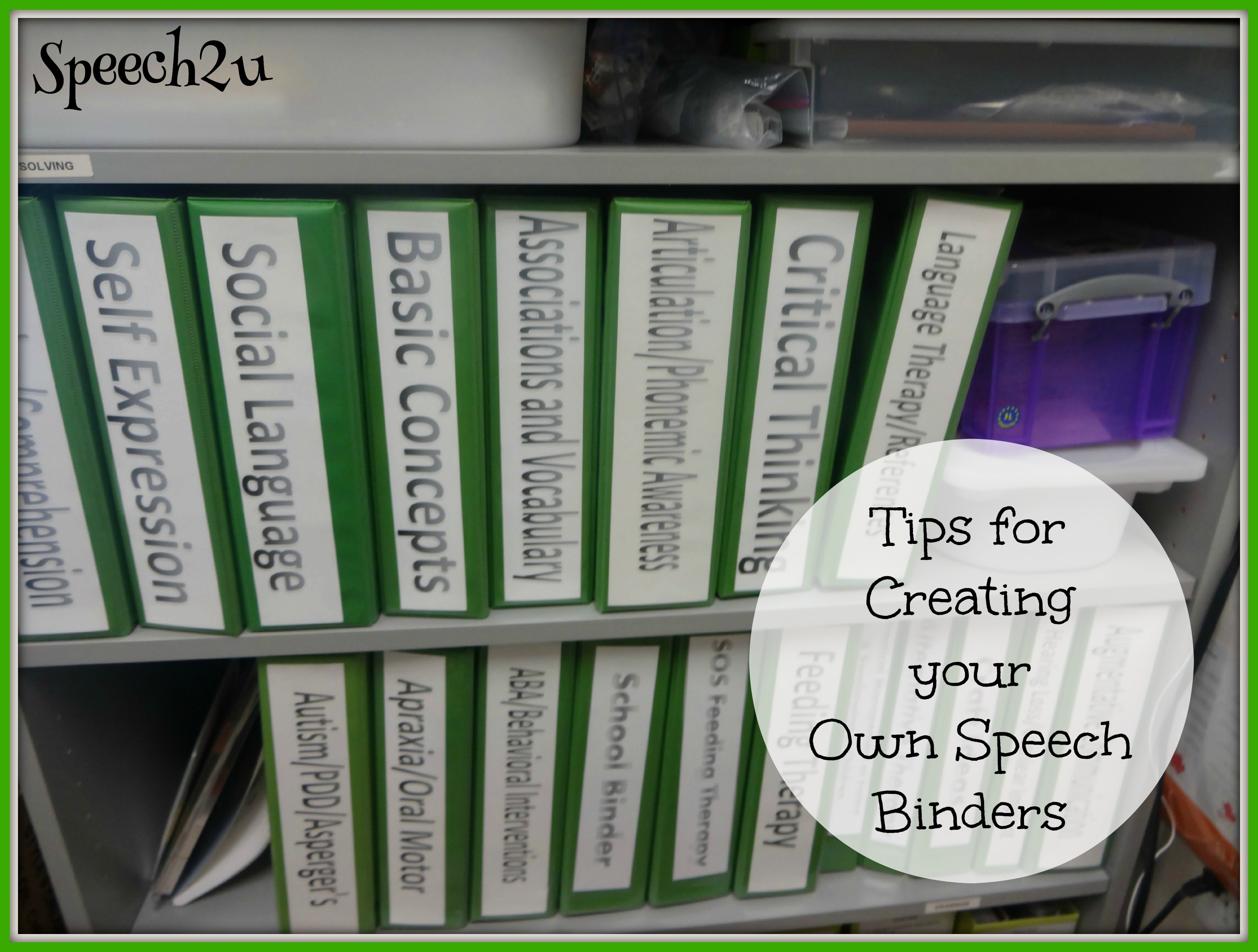
I have several binders full of resources, therapy ideas and articles that I’ve found over the years. Part of my job is supervising other therapists, so I find that I use these more when providing suggestions or ideas for others. I have resource binders for feeding, autism, behavior/ABA, alternative therapies, general language resources and augmentative communication. Here’s how I’ve organized some of my resource binders: I start each binder with a GOAL tab where I can include sample goals. Eventually I’ve moved some of these to our goal bank but it is helpful to look at if I’m trying to think of goals or areas to work on. The rest of my resource binders include research articles, handouts, and information related to the main topic. For example, I have information on PECS, Hyperlexia, Floortime, SCERTS therapy, RDI, and other programs in my binder on Autism. I also include some sample social stories, information on visual supports, and even a section on toileting. This is pretty dorky-but I usually take notes when I go to CEU courses and then come home and type them out. I keep these notes in my binders too. I’m working on organizing my language binders. Sarah Peterson has some fantastic tips on how to organize language binders in a hierarchy of skills for a variety of areas (ex. Critical thinking, basic concepts). I’m not going to share that information because she spent a lot of time deciding and figuring out what made sense to her. Check out BER seminars to see if she is coming to your area! (She also has amazing ideas for how to organize smaller therapy spaces.) I AM going to share how I am trying to reorganize my speech materials and information from CD’s.
Vocabulary:
- General vocabulary lists (ex. first 100 words, Tier 2 vocabulary by grade level etc.)
- Associations
- Analogies
- Synonyms
- Antonyms
- Word retrieval strategies and activities
- Prefix/suffix/root words
Concepts
- Sample Goals
- Developmental Norms
- Visual Attributes (color, pattern, shapes)
- Touch attributes (soft, hard, bumpy)
- Size attributes (big/little, long/short)
- Sound attributes (loud, quiet, rattling)
- Spatial concepts
- Temporal concepts
- Sequential concepts
- Quantity concepts
Multiple Meaning Words/Figurative language:
- Sample Goals
- Multiple Meaning Words
- Homophones
- Homonyms
- Idioms
- Jokes/Humor
Categorization: (I have so many resources-that I ended up creating my own binder for this)
- Category lists and pictures
- Sample goals
- Category Sorting
- Category labeling
- Category naming
- What does not belong
WH Questions:
- Goals
- Fill in the Blank activities
- Who
- What
- Where
- When
- Why
- How
- Mixed Questions
- Paragraph level comprehension-5 W’s worksheets
Listening:
- Sample Goals
- Whole Body Listening
- Active listening strategies
- Absurdities
- Auditory discrimination
- Targeted listening activities (ex. raise your hand when you hear something that didn’t belong-or raise your hand when you hear a person’s name)
- Single step directions
- 2-3 step directions
- Conditional directions
- Before/after directions
- Main idea/details
- Short paragraph/story comprehension
Syntax:
- Goal Lists
- Target lists for irregular plurals, verbs, etc.
- Auxiliaries is/are
- Regular Past tense
- Irregular Past tense
- Regular Plurals
- Irregular plurals
- Pronouns
- Future tense forms
- Conjunction
- Question reversals
- Noun + verb agreement
- Scrambled sentences
- Writing activities
- Goals
- Assessment checklists
- Sample social skills programs
- Play skills
- Pragmatic language and play skills developmental norms
- Emotion pictures
- Situational based emotions with pictures
- Thought bubble activities
- Nonverbal language
- Theory of mind
- Eye contact/eye gaze activities
- Expected/unexpected activity ideas
- Perspective taking actives
- Conversational activities
- Asking Questions
- Making comments
- Goal ideas
- Sequencing-Procedures
- Sequencing-story retell
- Paraphrasing
- Summarizing
- Narratives
- Goal ideas
- Compare/contrast
- Fact/opinion
- Identifying problems
- Identifying causes
- Making and explaining inferences
- Providing solutions
- Predicting
- Developmental norms
- Auditory discrimination
- Phonemic Awareness
- Gestural cues
- Specific phoneme cues/techniques
- Articulation activities
- Phonology activities
- Apraxia activities
- Minimal pairs/contrast phrases
- R and S activities
- Intelligibility
- Carryover
- Goal ideas
- Assessment checklists
- Communication signal inventories
- Low tech activity ideas
- Core word handouts
- Dynavox information
- LAMP
- iPad AAC app information
- Vocabulary storage ideas
- Activity ideas
- Learned helplessness
- Joint Activity routines
- Communication logs
- Lesson plans
- Charting sheets
- Scripting

Okay, so I understand…. Your binders just hold worksheets, reference articles and information (therapy strategies?) but you don’t actually keep your TPT/self-made therapy materials in those notebooks. Is that right?
Not in these binders. I’m still searching for the best TPT organizational system. Currently I have 4 plastic drawers that I separate based on social skills, grammar/expressive language, articulation/open ended games., comprehension. I cut out individual products and store in plastic bags in the corresponding drawer. I think there is probably a better option but am still working on it!
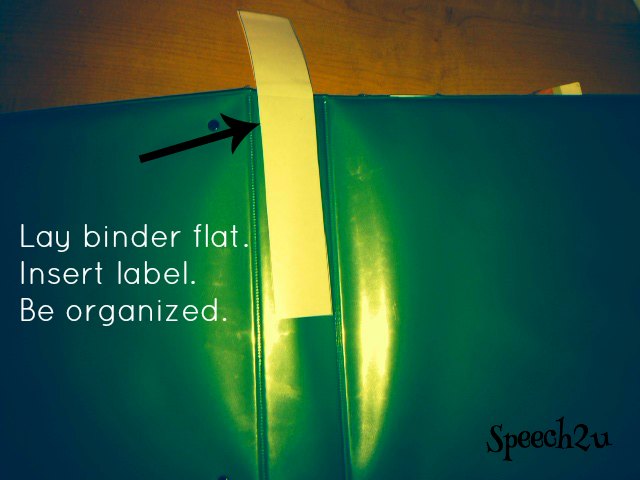
I never knew that trick to get the labels to go in! This could be life changing 🙂 Thanks!
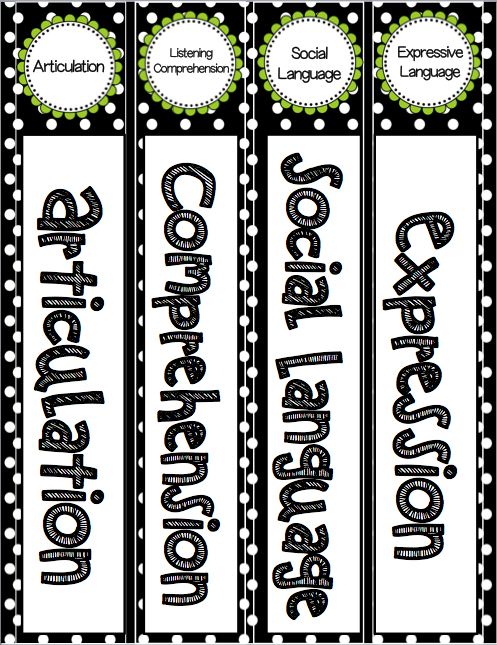
I love your binder spine labels. Can you share your blank binder spine template and the font used so I can make others I need? Thanks!
Hi Deb,
I’m so happy that you like these! I don’t have an editable version available right now-but I am going to work on it in the next few weeks and will have it posted-with maybe 1-2 more designs on Thursday, September 24th.